
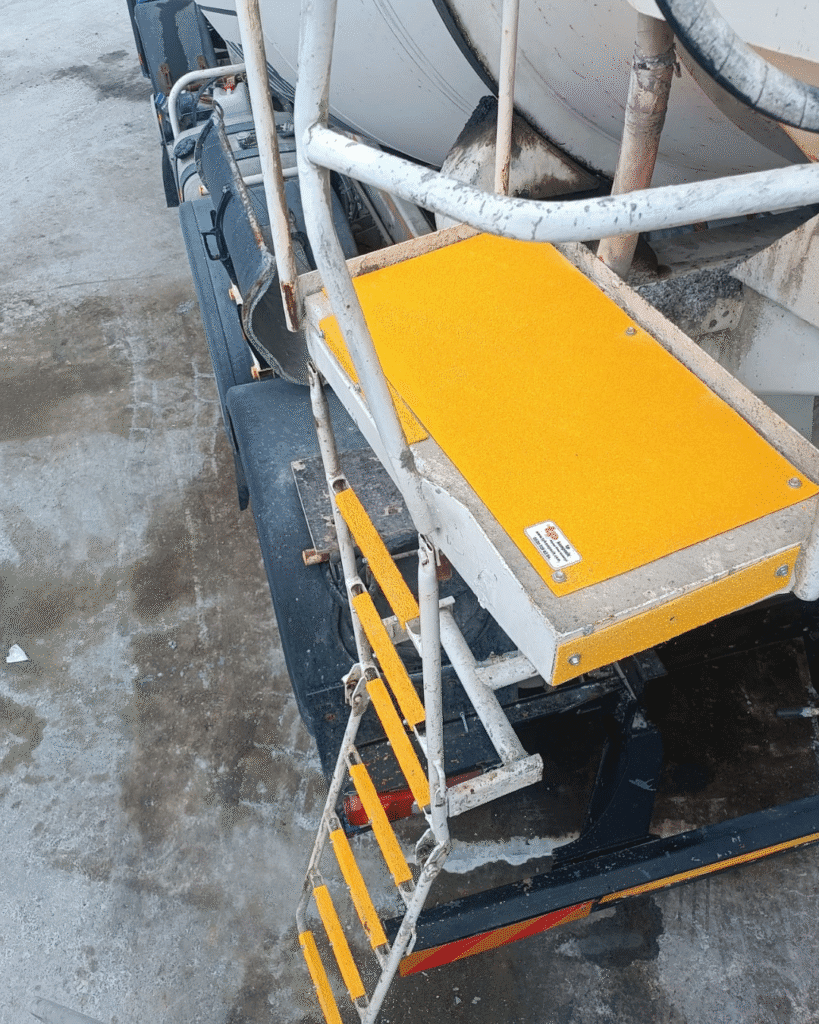
GRP/FRP Anti-slip rung covers: Technical specifications and engineering solutions
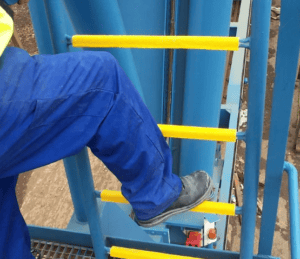

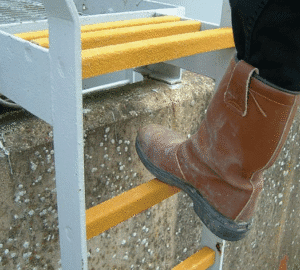
GRP FRP Anti-slip rung covers ;Industrial ladder accidents are not merely a matter of “slipping”—they represent a complex problem at the intersection of materials science, tribology, and electrical engineering. GRP/FRP ladder rung covers are engineering marvels that solve this interdisciplinary problem at its root.
Material composition: Nanotechnology layering
The multi-layered composite structure that forms the foundation of our product:
- Surface Layer (Wear Layer):
- 40% silisyum
- 2200-2500 Knoop hardness value
- 9.5 Mohs hardness scale
- Optimal particle size distribution: 80-120 microns
- Intermediate Layer (Structural Layer):
- E-glass fiber weave (450-600 g/m²)
- Isophthalic polyester resin matrix
- Optimized Glass/Resin ratio: 65%/35%
- Number of plies: 3-5 (depending on thickness)
- Base Layer (Bonding Layer):
- Thermoplastic polyurethane base
- Viscoelastic properties (-40°C/+120°C)
- Shock absorption capacity: >35%
Mechanical performance data
| Test Parameter | Value | Standard |
|---|---|---|
| Compressive Strength | 145-165 MPa | ISO 604 |
| Flexural Strength | 210-240 MPa | ISO 178 |
| Impact Resistance (Charpy) | 45-55 kJ/m² | ISO 179 |
| Friction Coefficient (Oily Surface) | 0.85-0.92 | DIN 51130 |
| Abrasion Resistance | <100 mg/1000 cycles | ISO 4649 |
Electrical insulation properties
- Dielectric Strength: 28-32 kV/mm (IEC 60243)
- Surface Resistance: >10¹² Ω (IEC 62631-3-2)
- Arc Track Resistance: 600 V (IEC 60587)
- Corona Inception Voltage: >8 kV
Chemical resistance matrix
| Chemical | Concentration | Exposure Time | Performance |
|---|---|---|---|
| Sulfuric Acid | 30% | 1000 hours | 98% Retention |
| Sodium Hydroxide | 20% | 1000 hours | 96% Retention |
| Diesel Fuel | 100% | 2000 hours | 99% Retention |
| Seawater | 3.5% Salt | 5000 hours | 100% Retention |
| UV Radiation | 1000 W/m² | 3000 hours | ΔE<3 |
Manufacturing technology and quality control
Advanced manufacturing process
- Pre-impregnation: Resin saturation of glass fiber
- Compression Molding: 150-180°C, 50-80 bar pressure
- Post-curing: Controlled polymerization (24 hours)
- Surface Treatment: Grit application and coating
Quality assurance protocols
- FTIR analysis every 10th part
- DSC testing per lot (polymerization control)
- Daily Shore D hardness measurements
- Dielectric testing with every production run
Installation engineering
- Snap-fit design: 0.5-1.0 mm interference fit
- Thermal gap calculation: ΔL = α·L·ΔT
- Vibration damping: 15-25 Hz resonance control
- Creep calculation: <0.5% deformation (20 years)
Industrial validation testing
Simulation and FEA analysis
- ANSYS Mechanical: Stress distribution analysis
- COMSOL Multiphysics: Thermal-electrical coupling
- Abaqus Explicit: Impact and drop testing
- SolidWorks Simulation: Fatigue life prediction
Field Performance Data
| Industry | Average Lifespan | MTBF* | ROI |
|---|---|---|---|
| Offshore Platform | 8-10 years | 15,000 hours | 213% |
| Chemical Plant | 7-9 years | 12,000 hours | 187% |
| Power Plant | 10-12 years | 18,000 hours | 245% |
| Shipbuilding | 6-8 years | 10,000 hours | 176% |
*MTBF: Mean Time Between FSustainability and Environmental Impact
Life Cycle Analysis (LCA)
- Production Energy: 45-55 MJ/kg
- Carbon Footprint: 3.2-3.8 kg CO₂/kg
- Recycling Rate: >85%
- End-of-Life: Thermal recovery 25 MJ/kg
Smart manufacturing and lot integration
Digital twin technology
- QR-coded digital identity for each part
- Blockchain-based production records
- Predictive maintenance algorithms
- Real-time wear monitoring
Sensor integration
- Embedded strain gauges
- Temperature sensors
- Slip detection algorithms
- Wireless data transmission
Conclusion: engineering excellence
GRP/FRP ladder rung covers are not ordinary safety products—they represent the synergistic integration of materials science, mechanical design, and electrical engineering. Each product is:
- Designed using scientific methodology
- Manufactured with advanced technologies
- Validated through comprehensive testing protocols
- Subjected to continuous improvement processes
Our Technical Excellence Promise:
“Every specification is provable, every claim is testable, every performance metric is measurable.”ailures